Implementation of agrophysical activities.
One of the factors determining soil fertility in obtaining a high yield from agricultural crops is its physical properties. Agricultural crops develop well and produce abundant crops only when sufficient moisture and nutrients, optimal agrophysical and microbiological conditions are maintained in the soil.
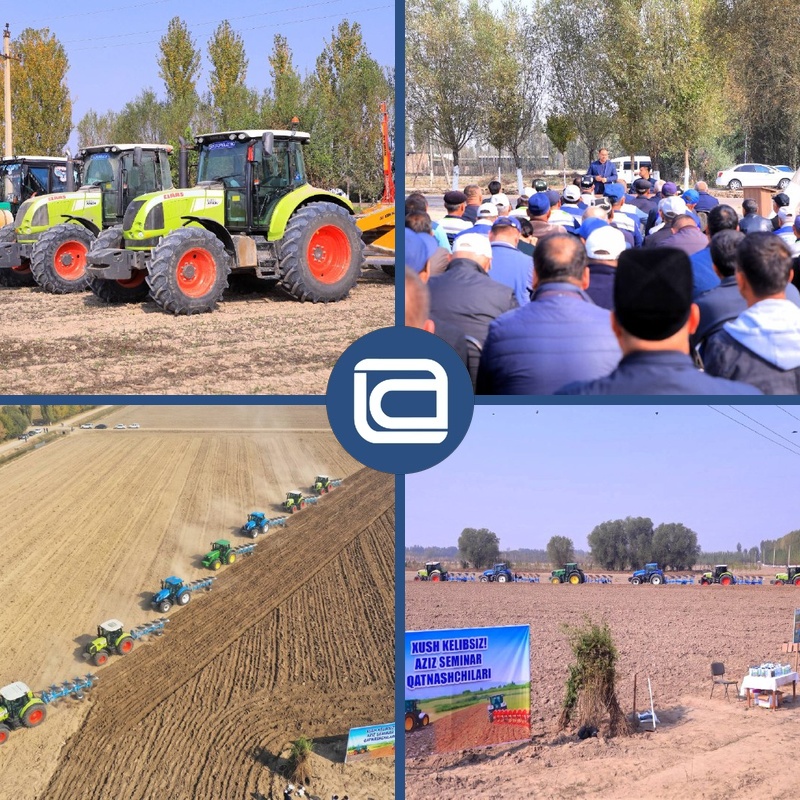
Saline soils are affected by 1.3-1.5 times more machinery than non-saline soils, and these soils are strongly compacted under the influence of heavy tractors and other weapons. Therefore, in order to prevent compaction processes in the arable and driving layers of the irrigated saline soils, it is advisable to use less heavy wheeled tractors, to organize tillage at the level of physical maturity of the soil;
When determining irrigation standards, it is necessary to take into account the types of soil, their water-physical properties, the depth of seepage, and whether the fields are provided with ditches. Crops should be irrigated at the rate of 700 to 900-1100 m3 when the soil moisture is 65-70 percent of the moisture capacity of the field;
Depending on the type, variety, biological characteristics and soil-climatic conditions of the crops, organizing irrigation in hydromodule regions and preventing excessive water consumption;
Planting and mulching cotton and wheat seeds in the paddy fields, applying stratification taking into account the soil conditions;
In order to prevent compaction processes in plowed and under plowed layers of irrigated soils, it is necessary to reduce the use of heavy wheeled tractors, to organize tillage at the level of physical maturity of the soil, and to deepen the layers of gypsum and under plowed compacted soils.